This guide explains how an Ageism Questionnaire helps organizations measure age-related bias in hiring, training, and career progression. It offers objective background on what “ageism” means, why assessment matters, and how to structure questions responsibly. You’ll also find practical criteria for administering the tool, plus an expert-informed FAQ to support consistent, ethical use.
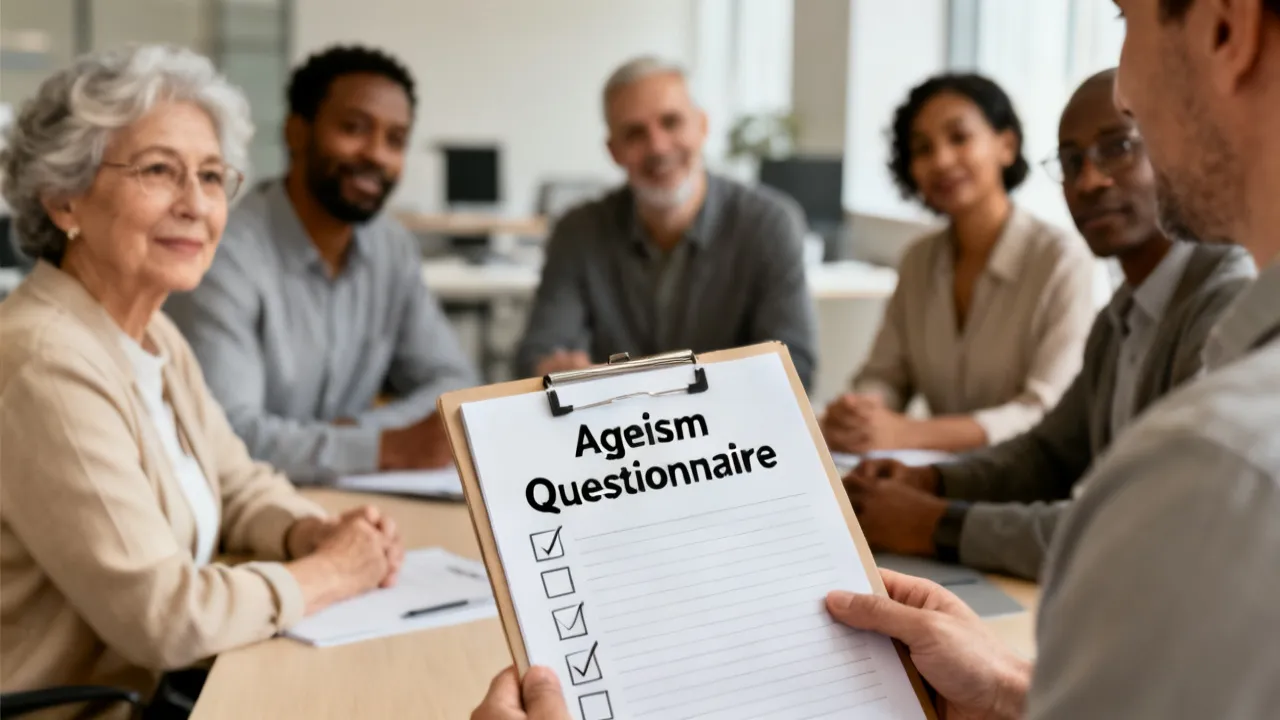
An Ageism Questionnaire is a structured, research-oriented instrument that helps organizations identify patterns of age bias across everyday workplace processes—such as recruitment, onboarding, learning opportunities, performance evaluation, and mentoring. Used thoughtfully, it supports objective diagnosis rather than relying on impressions, which often differ between managers, employees, and HR teams.
In many organizations, fairness is discussed in broad terms—values statements, leadership commitments, or training slogans. Yet employees experience fairness through concrete systems: the criteria used to screen applicants, the way managers select people for stretch assignments, the rules that determine who qualifies for training budgets, the expectations embedded in performance reviews, and the informal sponsorship networks that influence career momentum. Age bias can be embedded in all of these. Sometimes it is overt and easy to name; often it is subtle—expressed through “reasonable assumptions” about adaptability, stamina, readiness for leadership, or how quickly someone can learn new tools. Because these assumptions are frequently normalized, they may not be perceived as discriminatory by those who apply them, and they may not be recognized as discriminatory by employees who are simply trying to do their job.
That is where a credible Ageism Questionnaire becomes important. It creates a consistent way to collect employee experience and perception data across multiple touchpoints. It helps an organization ask: Are people of different age groups experiencing consistent access to opportunity? Are they being treated with similar respect? Do managers and colleagues communicate in ways that imply expectations tied to age? Are evaluation standards applied consistently? Are there differences in how people are supported during change—such as new technology rollouts, reorganizations, or updated ways of working?
When executed well, the questionnaire becomes more than a survey. It functions like a fairness diagnostic: it surfaces patterns of concern, identifies systemic process gaps, and provides a foundation for measurable interventions. This matters because workplace fairness is not only about avoiding illegal discrimination; it is also about building the trust and psychological safety required for people to contribute at their best. Trust declines when employees believe decisions are based on hidden assumptions about who is “fit” for certain roles. An evidence-informed approach can help rebuild confidence—if it is paired with real action and transparent follow-through.
Ageism is not only about overt discrimination. It can also show up as subtle assumptions and differential treatment based on age—such as presumed lower learning capacity, stereotypes about adaptability, or exclusion from high-visibility projects. In workplaces, these issues may surface in multiple stages:
An effective Ageism Questionnaire aims to make these patterns measurable—without reducing people to categories. That “without reduction” principle is crucial: while age may be the variable the questionnaire measures, the tool should not imply that employees are interchangeable by demographic. Instead, the questionnaire should capture experiences and process outcomes that differ by age group.
In practice, ageism might appear as:
Because these patterns can be subtle, employees may describe them indirectly. They might report, for example, that suggestions “aren’t taken seriously,” that certain opportunities “never seem to come my way,” or that their manager “doesn’t check in as much.” A well-designed questionnaire translates those experiences into measurable items that can be analyzed at an aggregate level.
From an industry expert perspective, the reliability of any Ageism Questionnaire depends less on whether the questions “sound fair” and more on whether they are designed and implemented to produce consistent insights. Consider these critical goals:
Credible measurement also requires methodological discipline. A questionnaire that is too vague may capture frustration rather than fairness issues; one that is too long may cause fatigue and reduce data quality. A questionnaire that is too short may miss critical touchpoints or concentrate only on overt incidents. The best instruments often strike a balance: enough breadth to cover relevant processes, enough specificity to support meaningful interpretation, and enough consistency to allow tracking over time.
Clarity is especially important because “age” may not be mentioned in many bias experiences. Employees may not describe an event as “age-related”; instead, they may report it as a pattern: “I wasn’t invited to the meeting where decisions were made,” “I wasn’t considered when the team chose who would lead the project,” or “Feedback focused on ‘timeliness’ and ‘fit’ more than on performance.” If the questionnaire items are well aligned to these experiences, employees can respond accurately even when they do not label the underlying cause.
Coverage matters because ageism rarely occurs only in one area. A company might show strong hiring fairness but weak mentoring access, or strong development programs but inconsistent performance evaluation expectations. For instance, leadership tracks might be open to everyone in policy documents, but nomination practices may be influenced by manager assumptions about who is likely to stay or who is “ready.” A questionnaire that only asks about promotion fairness may miss barriers in development nomination; conversely, a questionnaire that only checks training access may miss evaluation or recognition bias.
Neutral wording reduces response distortion. If items imply wrongdoing (e.g., “My manager discriminates against people my age”), respondents who fear consequences may answer defensively—or may disengage. Instead, the questionnaire can ask about experiences and perceptions in a way that avoids accusations while still capturing fairness-related signals.
Even a well-written Ageism Questionnaire can fail if the administration process undermines trust or produces distorted data. Common pitfalls include:
It’s useful to consider why each pitfall occurs, and what mitigation looks like.
Insufficient anonymity is often the biggest barrier. Employees may worry that survey responses can be linked to them through combinations of demographics (small teams, unique roles), or through a belief that the organization can triangulate results. To mitigate this, organizations can implement technical safeguards (secure survey platforms), procedural safeguards (role-based data access), and reporting thresholds (e.g., only report group-level results when sample sizes are large enough to protect identity). Additionally, communications should be explicit: what is collected, who can access what, and how it will be reported.
Skewed sampling can occur when participation is uneven. For example, employees in certain locations may have less time to complete surveys, or shift workers may experience lower participation due to scheduling. This can lead to a mistaken belief that the rest of the workforce is “fine” when the evidence actually reflects participation differences. Mitigation includes targeted reminders, scheduling survey availability so that all employee segments have access, and monitoring participation rates by group to detect imbalances early.
One-time measurement only reduces value. Fairness interventions typically require time: policies must be updated, managers need coaching, and employees need to experience the changed process. If results are collected once and then nothing happens, employees learn that the survey is more performative than practical. Mitigation involves planning the measurement calendar upfront: baseline, follow-up after process changes, and periodic pulses.
No follow-up is a credibility-killer. Even if the questionnaire is scientifically sound, it fails morally and strategically if it is not connected to action. “Follow-up” does not always mean immediate structural change. It can mean publishing a plan: which levers will be adjusted, what timelines apply, what success metrics will be used, and what resources will be allocated.
Interpretation by untrained stakeholders can produce harmful misuses. Managers may treat perception differences as proof of personal misconduct. Legal or HR risk increases when survey results are used for discipline without proper process. Mitigation includes training those who read the results on the difference between perceptions and evidence, and establishing a governance process for how themes are translated into interventions.
When you analyze an Ageism Questionnaire, focus on trends and actionable themes. Avoid treating a single score as proof of wrongdoing by specific individuals. Instead:
Responsible interpretation also requires careful statistical thinking. A difference in average scores between age groups might be meaningful or might reflect differences in role mix, managerial style distributions, or the local environment. For instance, a higher perceived unfairness among one group could be explained by that group being more concentrated in a particular location, or more exposed to a certain manager population. That does not mean the concern is invalid. It means the organization should investigate the mechanisms rather than making assumptions about the individuals behind the data.
Another key point is to recognize that perception is not “imagined.” Employees are not sensors; they are human observers whose perceptions arise from the patterns they experience. Perception data is a form of evidence about the lived experience of the workforce. Yet perception data should still be treated as an indicator, not a definitive causal proof. The responsible approach is to treat perceptions as a prompt for inquiry: if people feel that opportunities are unequal, the organization should examine whether the eligibility and nomination systems function consistently across age groups.
Qualitative comments (optional open-ended prompts) can be powerful, but they should be governed carefully. The organization should avoid using a small number of comments to identify specific individuals. Comments should be analyzed thematically. Themes (e.g., “training invitations depend on who you know,” “feedback focuses on speed rather than outcomes,” “assumptions about readiness appear during reorgs”) can then feed into targeted process reviews.
Finally, interpretation should include a fairness check of the reporting itself. If the organization only reports findings that support a desired narrative, the instrument loses trust value. A responsible approach is to communicate both strengths and areas for improvement, while explaining what actions will be taken and what cannot be changed immediately.
Because age bias can be both direct and indirect, mature questionnaires usually combine several dimensions. While formats differ by organization, a strong instrument typically covers:
It can help to think of these dimensions as mapping onto the “employee lifecycle experience” within the company. Ageism can be present at any lifecycle step—pre-hire, early onboarding, growth and skill acquisition, performance cycles, promotion and leadership selection, and retention/redeployment during change. Even though a questionnaire often cannot capture pre-hire experiences (unless the organization also surveys candidates), it can capture the downstream fairness signals that matter most: how employees experience the systems that shape their career.
To make dimensions operational, expert questionnaires translate each dimension into items that refer to observable processes. For example:
Expert questionnaires also often incorporate items that distinguish between “perceived unfairness” and “action taken to address unfairness.” For instance, an employee may feel a barrier exists, but they may also feel the manager consistently takes steps to remedy it. Capturing both can help leaders prioritize whether they need process changes or accountability improvements—or both.
Below is a practical comparison of common implementation approaches, expressed as conditions/requirements. (This table does not include links.)
| Implementation approach | Key conditions/requirements | Top suited for | Primary limitation |
|---|---|---|---|
| HR-led internal questionnaire | Confidential collection; clear purpose statement; governance for data access; communication plan for follow-up actions | Organizations building baseline metrics | May face lower participation if trust is limited |
| Third-party administered survey | Vendor selection criteria; privacy safeguards; agreed reporting format; alignment with company policy processes | Organizations with high sensitivity or union considerations | Higher operational cost and longer timelines |
| Pulse + follow-up interviews | Repeat cadence; structured interview guide; documented decision workflow for themes; trained interviewers | Teams needing “why” behind survey patterns | Risk of narrative bias if interview samples are unrepresentative |
| Manager enablement integrated with measurement | Manager training; policy review triggers; coaching resources; measurable process changes tied to results | Organizations already committed to capability building | If training is symbolic only, employee trust can drop |
Below is a step-by-step approach commonly used in professional HR analytics projects to ensure the questionnaire is used ethically and effectively.
Clarify what leaders will do with the findings—e.g., revise promotion criteria, review training allocation, adjust onboarding practices, or strengthen reporting mechanisms.
To strengthen credibility, translate objectives into decision points. For example: if the questionnaire indicates that older employees perceive less access to leadership coaching, the decision point could be “revise nomination criteria for coaching and publish eligibility rules.” If it indicates that younger employees feel less respected during feedback, the decision point could be “update feedback training and require calibration meetings that evaluate outcomes rather than ‘attitude to learn.’” Decision points reduce the risk of survey results being discussed without practical consequence.
Decide whether the questionnaire covers the entire company or specific functions. Determine which employee groups to include while preserving privacy.
Scope affects both validity and protection of identity. In smaller units, age group comparisons may require careful aggregation to avoid identification. Scope decisions should also consider structural differences across business units—for example, if some units have different promotion systems, training models, or manager ratios. A credible approach either includes those variables in interpretation or stratifies analysis so that differences in process design do not get mistaken for bias signals.
Use a validated structure where possible. If adapting, pilot test language to ensure consistent interpretation across roles and experience levels.
Adaptation is common: organizations have different titles, different training processes, and different performance cycles. But adaptation should avoid changing meaning. Expert teams often maintain a “core” set of items unchanged to allow trend comparison, while adding contextual items that reflect local processes. This helps maintain measurement comparability across waves.
Define who can access results, what aggregation level will be used, and how long data will be retained. Communicate these rules clearly to respondents.
Governance also includes a data ethics policy. For example, it should state that survey results are used for systemic process improvement rather than individual discipline. It should also define how exceptions are handled—for instance, if the comments contain allegations of harassment or safety issues. Having a governance process in advance ensures that the organization responds appropriately without compromising confidentiality.
Run a small trial to test readability, timing, and whether items are misunderstood. Incorporate feedback without changing intent.
Pilots are not only for language clarity; they are also for sensitivity. Employees may interpret certain items through the lens of prior experiences with fairness initiatives. Pilots can detect misunderstandings early, such as whether employees interpret “opportunities” as only formal training or also informal project assignments. The goal is consistent interpretation.
Explain how results will be used and what will happen after analysis. Transparency improves response quality.
Communication is part of measurement validity. If employees believe the survey is a political tool or a prelude to blame, participation will drop or responses may become guarded. Organizations should explain what will not happen (e.g., no individual-level identification, no punitive discipline based solely on survey perceptions). Leaders should also share at least a high-level timeline for follow-up actions.
Use the same timeframe and survey channel for similar groups to avoid measurement distortions.
Consistency includes survey distribution and reminder cadence. If one wave uses one channel and another wave uses a different channel without considering participation patterns, comparisons become less reliable. A credible approach monitors completion rates and checks for systematic missingness (e.g., a subset of employees who never complete).
Review patterns by themes and groups. Avoid identifying individuals or making disciplinary conclusions from survey sentiment alone.
Defensible analysis can include segmentation by age band and by role families, along with controls or contextual interpretation. For example, if one age band has more representation in a region with major restructuring, leaders should consider whether changes in that environment affect responses. Interpretation should not deny the bias signal; rather, it should guide investigation toward the process levers that might be interacting with environmental change.
Link results to specific levers: nomination processes, interview rubrics, training eligibility, mentorship matching, and performance feedback standards.
This translation step is often where organizations struggle. Measurement yields insight, but process change requires ownership. Expert teams assign “process owners” for each lever and establish a change plan that specifies what will change, who will implement it, how success will be measured, and when employees will see differences. For example, if the survey suggests age-linked assumptions in hiring interviews, the process change could involve revising interview questions, standardizing rubrics, and training interviewers on structured evaluation and bias awareness. If it suggests recognition gaps, the change could include adjustments to performance calibration, recognition nomination rules, and manager coaching.
Publish a high-level summary of themes and planned actions. Repeat the Ageism Questionnaire after an appropriate interval to evaluate progress.
Reporting back should balance transparency with confidentiality. Employees want to know what the organization learned and what it will do. But the organization should not publish granular results that identify individuals. A responsible report includes: the top themes, evidence patterns (in aggregated form), planned interventions, expected timelines, and how employees can track progress. Repeating measurement creates a loop that reinforces trust.
Workplace fairness initiatives increasingly rely on measurement because perceptions can be hard to compare and progress can be difficult to demonstrate. Professional HR practice emphasizes that bias mitigation should be both evidence-informed and accountable. A properly designed Ageism Questionnaire functions as part of a broader compliance and culture toolkit—not as a standalone “solution.”
Traditionally, organizations implemented training workshops and policy documents to address bias. Yet training alone often fails to change systems. People can complete a training module and still experience unequal opportunity in practice—because the decisive moments happen in the “how we run things” layer. Measurement helps organizations examine that layer.
Another reason measurement is growing is the increasing availability of workforce analytics and survey technology. Organizations can collect aggregated experiences and link them to process metadata (e.g., training participation rates, promotion pipeline data, performance review cycle compliance). While age bias measurement must be careful and ethical, the broader capability to analyze patterns supports more rigorous decision-making.
Additionally, measurement addresses the credibility gap between leadership and employees. Leaders may believe policies are fair and consistently applied. Employees may feel that fairness is conditional. When an organization uses a credible instrument, it creates a shared evidence base. That shared base can make dialogue more productive because it reduces reliance on anecdote alone.
Finally, measurement is increasingly seen as a risk management practice. Fairness failures can lead to legal exposure, turnover, reputational harm, and productivity losses. By identifying early signals of age-linked unfairness, organizations can invest in prevention rather than responding after damage occurs.
Rather than providing a full ready-to-use instrument (which should be validated for your context), it is useful to understand what high-quality item themes typically look like. In an Ageism Questionnaire, items often examine whether employees experience or observe:
To deepen the usefulness of these themes, expert questionnaires often include additional item variants that capture different “mechanisms” of bias. For example:
Wording should be adjusted for reading level and translated carefully to preserve meaning. Translation is not merely linguistic; it is cultural. If a translated item shifts the connotation of respect, opportunity, or fairness, the response data may no longer measure the same underlying construct.
Validity is not just about survey wording; it is also about the conditions under which people respond. Common conditions that influence outcome quality include:
Timing requires nuance. Sometimes organizations want to survey immediately after a change because they expect emotions to reveal bias. However, if the organization does not communicate clearly and does not protect anonymity strongly, responses may be influenced by immediate conflict rather than stable experiences. Conversely, if leaders wait too long without action, employees might lose interest or perceive the effort as a formality.
Response environment includes not only technical security but also social context. If employees complete the survey on company devices while logged into personal accounts or under visible supervision, they may fear identification. Even if technically anonymous, perceived risk affects honesty. Providing survey access through private links, ensuring no managers can see who completed it, and clarifying data governance can reduce these concerns.
Training on interpretation is important because leaders may focus on the wrong metrics. For example, they might focus solely on the highest complaint item without investigating whether the root cause is access nomination, meeting inclusion, or performance standard differences. Training can help leaders read the results as a map to process investigation, not as a list of blame targets.
Consistency is also critical for trend measurement. If core items change each time, you cannot confidently say whether changes are due to interventions or due to measurement differences. Expert implementations preserve core items across waves and use additional optional items only when necessary.
A common misunderstanding is that an Ageism Questionnaire itself “solves” age bias. In reality, the questionnaire identifies patterns; it does not correct them. The organization must connect findings to operational levers. To do this successfully, it helps to think about the major levers through which age bias can influence outcomes.
Age bias in hiring often emerges through “soft” judgments: interview style, culture fit criteria, and assumptions about how quickly someone will adapt. Questionnaire findings related to hiring fairness may include themes like: interview questions feel irrelevant to the role; candidates are evaluated against unspoken expectations; or older applicants believe their experience is treated as a disadvantage.
Process changes that address these concerns can include:
Age bias can be experienced early. New hires may discover that onboarding support is not consistent, or that “informal sponsorship” favors certain demographic groups. Employees may report that they are not invited into key informal networks or that they receive fewer opportunities to understand decision-making processes.
Process changes might include onboarding checklists, structured mentor assignment, and ensuring that onboarding resources (documentation, training, shadowing) are accessible and scheduled in time for all new hires. If questionnaire responses show that some age groups feel excluded from early collaboration, managers can be required to demonstrate onboarding inclusion through specific milestones (e.g., early meetings with cross-functional stakeholders, clarity on expectations, and equal access to knowledge-sharing sessions).
Learning access is a frequent pathway for bias. Employees may report that certain training opportunities are “for people who are ready,” with readiness interpreted through stereotypes. Older employees might be steered into narrower roles; younger employees might be encouraged into development tracks while others perceive that development resources are withheld until a later stage.
To address this, organizations can refine nomination processes and clarify eligibility rules. They can also audit training access by age group while ensuring compliance and privacy. A high-quality action plan often includes:
Performance cycles can embed age assumptions. Even when performance systems are “objective” on paper, the language used in feedback can reflect expectations about “pace,” “energy,” or “future potential.” Younger employees might be expected to show rapid learning, while older employees might be expected to show resilience to change—both expectations can become unfair if they are applied as stereotypes rather than tied to role-specific competencies.
Questionnaire items related to evaluation fairness may capture perceptions like: “My feedback focuses on how I compare to what a person in my age group should do,” or “I am evaluated for attitude toward change more than job outcomes.”
Process responses can include calibration and rubric review. For example:
Many unfairness experiences are not formal policy breaches; they occur in day-to-day interactions. A workforce can be fair in HR rules but still reproduce bias through informal networks. Employees may perceive that certain age groups are not invited to meetings, do not receive equal recognition in group settings, or have their ideas dismissed.
Questionnaire findings might show lower scores for items like “colleagues include me equally” or “my input matters.” These signals can guide interventions such as meeting facilitation training, rotating decision-making roles, and explicit behaviors for inclusive collaboration (e.g., asking for input in meetings, recognizing contributions regardless of seniority or age, and ensuring equitable distribution of “visible work”).
Importantly, organizations should avoid overcorrecting by forcing artificial inclusion. Instead, they should build inclusive meeting norms and empower employees to participate through clear expectations and supportive facilitation.
Ageism can intensify during change—technology upgrades, reorganizations, new processes, and changes in reporting structures. Stereotypes about learning speed or adaptability can become more visible. Older employees may be treated as if they “need more patience,” while younger employees might be treated as if they “won’t need support.” In both cases, the underlying issue is unequal support or unequal expectation.
If questionnaire responses show that one age group feels less supported during change, the organization can respond by revising change enablement processes. This can include tailoring training to roles (not to age), providing multiple support modalities (documentation, workshops, office hours), and ensuring all teams receive the same quality of onboarding to new tools. It can also include leadership communication that addresses stereotypes and reinforces that competence is role-specific, not age-dependent.
Even when fairness improves, employees will continue to consider whether reporting is safe and effective. Ageism questionnaires often include reporting climate items to measure whether employees trust that concerns will be handled constructively.
Process changes may include clear escalation pathways, training for those who receive concerns, non-retaliation commitments that are communicated and enforced, and timely feedback about what was done after concerns are raised. If the questionnaire indicates that employees fear dismissal or retaliation, accountability must be addressed before other improvements can gain full trust.
An Ageism Questionnaire is a structured set of questions designed to capture employees’ experiences and perceptions related to age bias at work. It can assess whether people feel treated fairly in areas like opportunities, recognition, evaluation, communication, and inclusion.
In an expert implementation, the questionnaire measures perceptions that reflect the lived experience of employees and aims to identify systemic process issues. It typically uses validated item formats (often Likert scales) and may include optional open-ended prompts to understand context while avoiding overinterpretation of individual stories.
It is not a legal determination by itself. Instead, it can serve as internal evidence to inform HR risk management, policy improvements, training priorities, and culture initiatives. Legal conclusions generally require broader investigation and appropriate professional guidance.
That said, organizations should still treat questionnaire data with legal seriousness. Proper governance, confidentiality protections, and careful interpretation help prevent misuse. Survey results should not be treated as definitive proof of discrimination in any individual case.
Use secure data collection, define access roles, report results only in aggregated form, and communicate these rules clearly. If employees believe their answers can be linked to them, response quality typically declines.
Confidentiality is both technical and psychological. Technical measures include secure survey platforms, limited access to raw data, and minimum reporting thresholds. Psychological measures include transparent communication about what HR can and cannot see, and reinforcing that the survey is used for systemic improvement rather than individual blame.
A common pattern is baseline measurement followed by periodic pulses (e.g., annually or after major policy changes). The right interval depends on organizational change cycles and the time required for process improvements to take effect.
Some organizations run an initial baseline and then a second wave after targeted interventions (for example, after revising nomination processes or updating performance feedback training). After that, annual or semi-annual pulses can be used to track ongoing fairness signals while keeping the core items stable for comparability.
Optional open-ended prompts can add context and help explain themes found in quantitative items. However, they should be reviewed carefully to avoid using individual narratives as the basis for disciplinary actions.
A recommended approach is to treat open-ended responses as thematic insights. Organizations can analyze patterns (e.g., repeated references to training invitations being late, or repeatedly described feelings of disrespect in meetings) and then connect themes to process levers. Leaders should avoid “story chasing,” where they try to identify who wrote a comment.
Translate themes into process changes. For example, if employees report unequal access to training, review eligibility rules and nomination practices. Then communicate what changes will happen and how you’ll measure impact in a follow-up cycle.
It helps to prioritize actions by feasibility and impact. Organizations can create a roadmap that assigns each theme a process owner and defines success measures. Success measures can include improved questionnaire scores, changes in training participation patterns, improved perceptions of feedback fairness, and improved reporting climate signals over time.
Yes, but only in ways that maintain confidentiality and statistical defensibility. Use aggregated comparisons and interpret differences cautiously, considering differences in role types, tenure distribution, and local management practices.
Comparisons should not automatically be treated as causal evidence. A difference might reflect that one age group is more represented in certain job families or regions. A responsible approach investigates process differences and ensures that comparisons do not inadvertently identify individuals in small groups.
Risks include low participation, misinterpretation of perception data, “survey fatigue,” using results to target individuals, or collecting feedback without meaningful follow-up. These failures can harm trust and reduce effectiveness.
Poor use can also include changing core items between waves without accounting for measurement differences, or reporting results in a way that violates confidentiality thresholds. When these risks occur, employees may disengage and fairness initiatives lose credibility.
Not always. If confidentiality and governance are strong internally, a company may administer the questionnaire effectively. A third-party can be beneficial when you need added independence, technical validation, or enhanced trust for high-sensitivity environments.
Third parties can also help with survey platform security, statistical analysis support, and unbiased communication. However, internal teams can still execute high-quality surveys if they adopt rigorous governance and communicate clearly.
An Ageism Questionnaire provides diagnostic insight. It should be paired with concrete interventions such as inclusive hiring rubrics, development and mentorship systems, fair performance feedback practices, and manager training grounded in observed process issues.
In a comprehensive fairness program, the questionnaire is one component: it feeds into policy reviews, manager enablement, accountability structures, and ongoing monitoring. The key is that interventions target the mechanisms suggested by the data rather than relying on generic training alone.
To keep this topic grounded, it is helpful to consult established guidance on employment discrimination and workplace fairness from reputable organizations. For example, many national equality bodies publish frameworks addressing age-related discrimination, and international labor references discuss non-discrimination principles and equal employment opportunity. These sources emphasize that bias mitigation typically requires both policy compliance and organizational behavior change supported by evidence.
Source examples to consider for background: United Nations guidance on non-discrimination principles; International Labour Organization materials on decent work and equality; and national equality bodies that publish age discrimination education resources. (If you share your country, I can suggest the very relevant official bodies and terminology used there.)
When consulting sources, it can be helpful to distinguish between (a) legal definitions and prohibitions, (b) organizational guidance on best practices, and (c) measurement frameworks for workplace inclusion. While the questionnaire is not a legal determination, it sits at the intersection of organizational best practice and evidence-based culture improvement.
Ultimately, an Ageism Questionnaire is very valuable when it becomes a repeatable system: measure fairly, interpret responsibly, act on process levers, and communicate progress. In that sense, the questionnaire is not the endpoint. It is the starting point for building a workplace where employees experience consistent opportunity, respect, and evaluation standards—regardless of age.
For lasting impact, the organization must treat the questionnaire as part of an ongoing governance loop. Measurement creates awareness; action creates change; follow-up measurement verifies improvement. When that loop operates effectively, employees are not only asked for feedback—they see their feedback lead to meaningful adjustments in how work decisions are made.
Durable change also depends on leadership behavior. Leaders set the tone for how results are discussed. If leaders treat the questionnaire as a blame tool, employees will become guarded. If leaders treat it as a diagnostic tool for improving systems, employees are more likely to participate honestly and to collaborate on solutions. Over time, this can reshape culture by normalizing fairness-oriented process thinking: decisions are evaluated by whether they create equitable outcomes, not by whether they feel subjectively “reasonable.”
When implemented with credibility—confidentiality, methodological rigor, and visible follow-through—an Ageism Questionnaire can support organizations in identifying where age-linked assumptions affect everyday workplace fairness, and in building a work environment where all employees can contribute and grow without being constrained by stereotypes.
Using an Ageism Questionnaire for Fair Workplace Practices

Using an Ageism Questionnaire for Fair Workplace Decisions
Using an Ageism Questionnaire for Workplace Fairness
Using an Ageism Questionnaire for Fairer Workplaces
Using an Ageism Questionnaire for Fairer Workplaces

How an Ageism Questionnaire Supports Workplace Fairness
Practical Use of an Ageism Questionnaire in Organizations

Using an Ageism Questionnaire for Fair Workplace Culture

Using an Ageism Questionnaire for Fairer Workplaces

Using an Ageism Questionnaire for Fair Workplace Decisions
This guide explains how to design, administer, and interpret an Ageism Questionnaire to support fair hiring, retention, and training decisions. Ageism in employment affects communication, evaluation, and access to opportunities. Background sections define the concept, outline measurement principles, and connect questionnaire results to practical interventions. You’ll also find a conditions-and-requirements comparison and a step-by-step approach for responsible use.
Using an Ageism Questionnaire for Workplace Fairness
This guide explains how an Ageism Questionnaire helps organizations detect age bias, improve HR decisions, and strengthen inclusion. It provides objective background on the concept of age discrimination, what such tools assess, and why structured evaluation matters in hiring, promotion, and learning opportunities. The article also covers practical implementation conditions, supplier considerations, and FAQs for steady governance.
Using an Ageism Questionnaire for Fairer Workplaces
This guide explains how an Ageism Questionnaire helps organizations measure age-related bias in hiring, training, and career progression. It offers objective background on what “ageism” means, why assessment matters, and how to structure questions responsibly. You’ll also find practical criteria for administering the tool, plus an expert-informed FAQ to support consistent, ethical use.
How an Ageism Questionnaire Supports Workplace Fairness
This guide explains how to use an Ageism Questionnaire to detect age-based bias in workplaces and public services. It then provides objective background on what “ageism” means, why structured measurement matters, and how organizations can translate results into fairer policies and training grounded in reliable research and common compliance principles.
Practical Use of an Ageism Questionnaire in Organizations
This guide explains how to use an Ageism Questionnaire to identify age-based bias in workplaces, inform fair training, and improve inclusion. Ageism Questionnaire tools are grounded in established research on discrimination and organizational behavior. The article compares implementation pathways, required conditions, and practical scoring considerations, with an expert view and FAQ coverage.
Using an Ageism Questionnaire for Fairer Workplaces
This guide explains how to use an Ageism Questionnaire to identify age-related bias, reduce risk, and improve workplace fairness. “Ageism” refers to discriminatory attitudes or practices based on age; an Ageism Questionnaire is a structured tool used for awareness, assessment, and targeted improvements. Background sections outline why measurement matters, what to look for, and how to respond responsibly.
